

Capgemini × UTS Consulting Club
Interstellar Bank: Digital Transformation Strategy
A five-year strategy to reduce loan processing friction and improve digital adoption.
We developed a transformation roadmap for Interstellar Bank's loan processing division, using competitor benchmarking, operational diagnosis, cost modelling, ROI projection, and risk planning to propose a unified loan origination system: OneFlow.
Proposed system
OneFlow
The bank had a growth problem hiding inside its operations
Interstellar had lending potential, but slow internal processes limited its competitiveness.
Interstellar Bank had a strong home lending base, but its loan processing division was slowed by manual verification, fragmented workflows, outdated systems, and post-acquisition misalignment. The business problem was not simply a lack of digital tools — it was an operating model that could not scale efficiently.
3.5M
Existing customers across retail and business banking
A$80B+
Home loan portfolio — the bank's core revenue base
~15 days
Average loan processing time — 3× slower than competitors
1 acquisition
Lunar Savings, adding system and cultural complexity
The acquisition wasn't just a growth play — it created operational debt. Two different systems, two different cultures, and a management team still figuring out how to run one bank. That's where the real problem was hiding.
Loan delays were a symptom — the operating model was the problem
Our diagnosis showed that loan delays were caused by more than manual admin. Interstellar's process was affected by fragmented workflows, system crashes, outdated platforms, data sync errors, unclear leadership, staff skill gaps, and inconsistent adoption across teams.
01
Process
Manual verification, slow approvals, duplicated work, and unclear handoffs across the loan journey.
02
Technology
Outdated loan platforms, data sync errors, unreliable systems, and limited workflow visibility.
03
People
Post-acquisition misalignment, staff skill gaps, low morale, and resistance to new digital workflows.
Benchmarking showed where Interstellar was falling behind
Competitors were faster, and speed was tied to customer experience.
We benchmarked Interstellar against major Australian banks and found a clear performance gap. Interstellar's estimated loan processing time was around 15 days, compared with approximately 5 days for leading competitors. This suggested that loan speed was not just an internal efficiency metric — it affected satisfaction, trust, and competitiveness.
Estimated loan processing time
Estimated figures based on benchmark analysis from the project deck.
If Interstellar wanted to compete in home lending, improving loan processing speed had to become a business priority — not just an operational clean-up task.
The opportunity: make loan processing a competitive advantage
The strategy needed to improve speed, visibility, adoption, and operational control.
The research pointed to one clear direction: modernise the loan origination process while helping staff adopt the new workflow. We framed the opportunity around two connected layers — a unified system for processing loans and a people strategy to support behavioural change.
How might we
How might Interstellar reduce loan processing friction while helping staff and customers confidently adopt a more digital lending experience?
OneFlow: a unified loan origination system
A connected operating system for customers, staff, and loan operations.
OneFlow was proposed as a unified loan origination system that connects customer intake, document verification, credit assessment, workflow prioritisation, approval tracking, and staff dashboards. The goal was to reduce manual handling while creating clearer visibility across the loan journey.
Step 01
Customer submits loan application
Step 02
OneFlow extracts and verifies documents
Step 03
Risk and urgency are prioritised
Step 04
Staff review exceptions
Step 05
Customer tracks approval status
Step 06
Feedback loop improves operations
System layer
Adoption layer
Making the strategy tangible through workflow prototypes
The prototype showed how OneFlow could change both the customer and staff journey.
To make the transformation strategy easier to understand, we created customer-facing and staff-facing prototype touchpoints. The customer flow showed how digital onboarding, document upload, credit assessment, real-time approval tracking, and AI support could reduce uncertainty. The staff-facing dashboard showed how teams could monitor platform status, prioritise applications by risk and urgency, check document completeness, and identify opportunities at the point of approval.
We weren't testing whether the UI looked polished. We were testing whether the workflow logic made sense to a stakeholder audience — could someone follow the loan journey end-to-end just by looking at these screens?
Group 1
Customer-facing flow
Reduces uncertainty during the loan application journey.
Let's get started
Personal loan · about 10 minutes
Loan Details
Loan amount
$100,000
Loan purpose
Home renovation AI
Term
36 months
Repayment frequency
Monthly
Your Details
Full name
Sarah Mitchell
Upload your documents
Photo ID — Passport
Identity confirmed
Payslips (3 months)
Income $6,200/mo extracted
Bank statements (90 days)
AI scanning transactions
Employment letter
Not yet uploaded
Credit assessment
Top 15% of applicants
2.5
DTI Ratio
0
Missed Payments
4 yrs
Employment
Your profile outperforms 85% of applicants this month. Income stability over 4 years with zero gaps detected. First-time borrowing is your only flag, offset by strong employment tenure and a DTI of just 2.5.
Under review
Our team is finalising your application
REAL-TIME TRACKER · #INS-2024-08843
Documents verified
Today 10:42 AM
Credit check completed
Today 10:45 AM
Application under review
In progress · est. 2 hours
Compliance sign-off
Pending · ~1 hr
Final approval decision
Pending
↑ Moving 8 mins faster than average — same-day approval likely
Estimated Decision
Today by 3:00 PM
Based on current queue and your profile
AI Loan Assistant
⚡ Powered by Interstellar AI
Hi Sarah 👋 I'm your Interstellar loan assistant. Your application #INS-2024-08843 is in workflow review. How can I help?
How long will the review take?
Based on your profile and today's queue, I estimate 1–2 hours. You're moving faster than average — documents were clean and credit cleared in 1.2 seconds. I'll push a notification the moment a decision is made.
Can you resend the employment letter link?
Done! Sent to sarah.mitchell@email.com and a push notification to your device. Tap below to upload directly.
Group 2
Staff-facing workflow
Gives teams visibility, prioritisation, and operational control.
Lisa Okafor
Sr. Loan Officer
Good morning, Lisa · Friday 11 April 2025
Dashboard
Data Migration
90%
Complete w/o downtime
LOS Platform
Live
Across all teams
Staff Trained
80%
+12% this week
System Uptime
99.5%
0 incidents
Loan Approvals
<4 wks
Avg 2.3 days
Sarah Mitchell
#INS-2024-08843
$25,000
Personal
James Kowalski
#INS-186842
$80,000
Business
Aisha Lim
#INS-186943
$12,500
Personal
Paulo Reyes
#INS-168842
$45,000
Vehicle
Risk & Urgency Queue
Sorted by AI risk score · SLA priority
Aisha Lim
#INS-186943 · $12,500
Marcus Webb
#INS-186901 · $67,000
James Kowalski
#INS-186842 · $80,000
Yuki Tanaka
#INS-186812 · $34,000
Sarah Mitchell
#INS-08843 · $25,000
Paulo Reyes
#INS-168842 · $45,000
SLA Countdown
Time remaining per application
Document Completeness
Colour = verified / missing / pending
Exception Review
Flagged items requiring manual review
Aisha Lim · #INS-186943
DTI of 68% significantly exceeds 40% limit. 4 missed payments in past 12 months. Manual review required.
Marcus Webb · #INS-186901
Income verification failed — employer ABN not found in ATO registry. Document re-upload requested.
Yuki Tanaka · #INS-186812
Passport expires within 6 months. Secondary ID requested for verification.
Sarah Mitchell · #INS-08843
Address on ID does not match bank statement. Minor discrepancy — flagged for staff confirmation.
Testing feasibility through cost, savings, and ROI
The recommendation included a high-level financial model, not just a feature proposal.
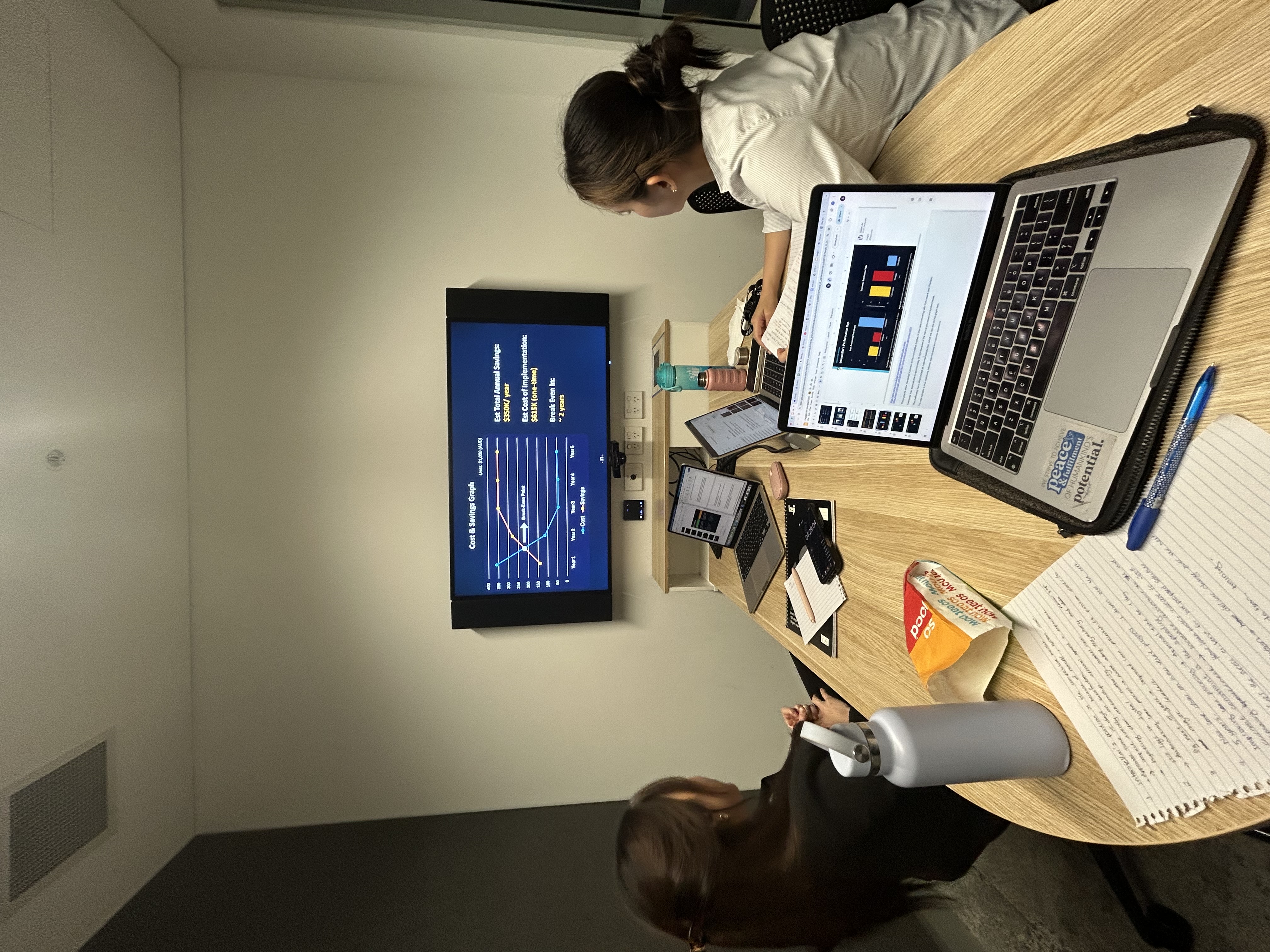
We estimated the implementation cost of OneFlow at A$615K, covering system development, integration infrastructure, compliance tooling, and training and change management. With projected annual operational savings of A$350K at full run-rate, the model estimated a break-even point of around two years and a five-year ROI of 139%.
A$615K
Estimated investment
Hover for details ↑
A$350K
Annual savings
Hover for details ↑
~2 years
Break-even
Hover for details ↑
A$855K
Five-year net benefit
Hover for details ↑
139%
Projected ROI
Hover for details ↑
Cumulative net cash flow
Investment breakdown
Figures are high-level estimates from the project model and should be read as directional, not audited financial forecasts.
A strategy is only credible if it can be implemented
We mapped a phased rollout across technology, people, and operational change.
The five-year roadmap balanced system rollout with organisational change. The plan moved from system design and training, to pilot testing, full launch, optimisation, and AI scaling. In parallel, the people and culture stream focused on value alignment, leadership unity, team incentives, and building a more integrated post-acquisition culture.
System design and architecture
Core build and pilot testing
Full launch
Optimisation and workflow refinement
AI scaling and continuous improvement
Staff training foundation
Value alignment
Leadership unity
Team incentives
One-team culture
Designing for adoption, migration, and risk
The strategy considered what could fail before rollout.
A recommendation is only as strong as its failure modes. Before presenting the strategy, we stress-tested it against three categories of risk: how staff might resist it, what could go wrong during data migration, and where AI-assisted verification could fall short. Each risk shaped the design of the rollout rather than being listed as a caveat at the end.
Staff resistance
Post-acquisition cultural tension between legacy bank staff and the new parent organisation could slow uptake and undermine the unified platform's effectiveness.
Mitigation
Phase in change champions early, tie incentive structures to platform usage milestones, and use Year 2 of the roadmap to focus on value alignment rather than system features.
Data sync and migration errors
Moving loan records, customer data, and credit histories across systems creates a window for corruption, duplication, or loss — especially given the acquired bank's fragmented legacy infrastructure.
Mitigation
Run parallel systems during the Year 2 pilot period. Require data reconciliation audits before sunsetting any legacy system. Scope rollout branch-by-branch to limit blast radius.
AI-assisted verification limits
Automated document checking and credit assessment could miss edge cases or introduce bias — creating compliance exposure and undermining customer trust if decisions feel opaque.
Mitigation
Human review gates at high-risk decision points. Regular model audits for bias and drift. Staff dashboard designed to make AI reasoning visible rather than hiding it behind a score.
Outcome: a transformation strategy with measurable business logic
The final recommendation connected operational pain points to cost, rollout, risk, and adoption.
The final output was a five-year transformation roadmap for Interstellar Bank's loan processing division. The recommendation addressed manual processing, fragmented workflows, digital adoption challenges, and customer uncertainty through a proposed unified loan origination system and change enablement plan. The business case projected a two-year break-even period and positive five-year return, while the rollout plan accounted for implementation risk and organisational adoption.
Strategic diagnosis
Identified bottlenecks across process, technology, and people.
Competitive benchmark
Compared Interstellar's loan processing performance against leading banks.
Business case
Modelled estimated cost, savings, break-even, and ROI.
Implementation plan
Proposed a phased roadmap with adoption and risk controls.
Projected outcomes were based on the project model and were not live implementation results.
Strategy is only as credible as the thinking behind it

What I learned
Working through the financial model taught me to question every number before committing to it — a habit that now shapes how I approach any design decision.
What was challenging
Digging deep into research to justify every number we presented. Unlike typical design work where you're solving for users, here we were building a recommendation for industry stakeholders — which required a completely different way of thinking and communicating.
What I'd do differently
Invest more time upfront in stakeholder mapping. We focused heavily on the operational diagnosis, but discovered late that understanding who needs to be convinced shapes every framing and design decision along the way.